

Run HR with accurate, connected data and reporting
Use HR analytics software to manage, report on and maintain accurate workforce data across HR, payroll and related systems – without relying on spreadsheets, manual exports or disconnected tools.

Move from fragmented reporting to consistent HR data
HR teams are responsible for maintaining employee data, supporting payroll processes and responding to internal and external reporting requirements.
Without a consistent approach, this often leads to:
- Inconsistent HR and payroll data makes it harder to maintain fair, accurate and consistent people processes across the organisation
- Time spent manually compiling reports reduces capacity for higher-value HR activities such as employee development and workforce planning
- Delays in responding to audits, reporting requests or business queries can create compliance risks and slow decision-making
- Reliance on spreadsheets and manual reporting increases the risk of errors and makes it harder to access information when it's needed

By connecting data across HR and payroll processes, HR analytics provides a reliable foundation for operational reporting and day-to-day data management.

“ADP’s centralised platform enabled us to gain valuable insights through improved reporting, eliminating the inefficiencies of managing multiple databases.”
— Payroll Manager, Next15
How HR analytics supports day-to-day HR operations
HR analytics is built into how HR and payroll data is captured, structured and accessed – enabling teams to manage reporting, compliance and operational processes more effectively.

Consistent HR and payroll data in one place
HR teams often need to reconcile employee records, payroll data and workforce information from different sources. HR analytics provides a single source of truth across connected systems.
- Employee, payroll and workforce data is maintained within a shared framework
- Common definitions help ensure information is interpreted consistently across teams
- Changes made in one system remain aligned across connected records and reports
HR teams work from consistent, comparable data – reducing discrepancies caused by multiple systems or manual handling.

Automated data flows and reduced manual reporting
HR teams often spend time exporting, combining and checking information before they can answer even simple reporting requests.
- Employee, payroll, time and absence data flows automatically between connected systems
- Updates are reflected as workforce information changes
- Manual exports, spreadsheets and reconciliation activities are reduced
Reporting relies less on manual effort – reducing errors, duplication and the time spent preparing data.

Real-time and on-demand HR reporting
Organisations make decisions every day about hiring, restructuring, workforce costs and employee support. These decisions are easier when current workforce data is readily available.
- Reports reflect current HR and payroll data
- Dashboards provide visibility into key workforce metrics
- Reporting can be configured by role, business unit or location
Information is available when needed – allowing HR teams to respond to requests, reviews and reporting requirements without delay.

Self-service access for HR teams
HR teams are increasingly expected to provide workforce insights while supporting employees, managers and business leaders across a wide range of priorities.
- HR teams can create and adjust reports using configurable fields and filters
- Standard reports are available for common HR and payroll requirements
- Access is controlled according to role and responsibility
HR teams can answer routine and ad hoc questions directly – reducing reliance on IT teams or external data support.

Compliance and audit reporting
Organisations are often required to demonstrate compliance, support audits and provide evidence for internal or external reporting activities.
- Records are maintained across HR and payroll processes
- Reporting supports compliance with employment, payroll and regulatory requirements
- Data can be accessed for audits, reviews and submissions
Compliance reporting is based on structured, consistent data – reducing the effort required to prepare and validate reports.

Cross-region and organisational reporting
As organisations grow, expand into new locations or operate across multiple entities, workforce data can become increasingly difficult to compare and manage consistently.
- Reporting spans multiple countries and organisational structures
- Local requirements are reflected within a consistent framework
- Comparisons can be made across business units or regions
Organisations can maintain a consistent view of HR data while supporting local reporting needs.
Supporting reporting across HR, payroll and finance
HR analytics is used across different functions to manage data and reporting requirements.

HR teams
Maintain employee records, run reports and support day-to-day HR operations.

Payroll teams
Validate payroll data, reconcile inputs and support reporting obligations.

Finance teams
Analyse workforce costs and support budgeting and reporting processes.

Compliance and legal teams
Access accurate records and reports for regulatory and audit requirements.
Getting started with HR analytics
1
Review your current data and reporting processes
Understand how HR and payroll data is currently captured, stored and reported
2
Identify key reporting and compliance requirements
Define where accurate, consistent reporting is needed across HR, payroll and finance
3
Introduce connected HR analytics
Implement structured reporting that brings together HR and payroll data into a single view
Explore related HR and workforce solutions
HR analytics works alongside other HR and workforce tools to support reporting, planning and day-to-day operations.

Manage employee data, workflows and records across the organisation.
Explore HR software
Analyse workforce trends, retention and long-term planning.
Explore people analytics
Monitor operational performance, staffing and labour efficiency.
Explore workforce analyticsFAQs
What is HR analytics software used for?
HR analytics software is used to manage, report on and maintain employee data across HR and payroll systems. It supports day-to-day HR operations by providing consistent, accessible reporting without relying on manual data handling.
How is HR analytics different from people analytics?
HR analytics focuses on the accuracy, reporting and management of HR data used in day-to-day operations. People analytics focuses on analysing workforce trends such as retention, engagement and long-term workforce planning.
How is HR analytics different from workforce analytics?
HR analytics supports HR processes such as reporting, compliance and data management. Workforce analytics focuses on operational performance, including staffing levels, scheduling and labour cost optimisation.
How does HR analytics support compliance and reporting?
HR analytics provides structured access to employee and payroll data, allowing organisations to generate reports required for audits, regulatory submissions and internal reviews without manually reconstructing data.
Start building a more accurate view of your HR data
By submitting this form you are informed that ADP may contact you about its products, services, and offers, according to our Privacy statement for Business contacts.
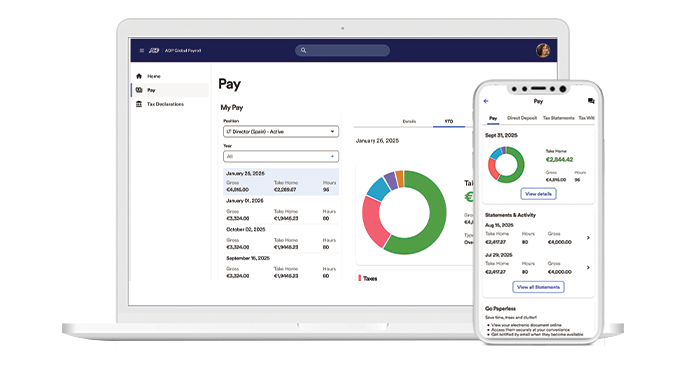
Let's find the perfect solution for your business
Fill out the form and see what the ADP team of payroll and HR experts can do for you.