

Performance management software that connects people, pay and performance
Managing performance consistently across teams can be difficult. ADP’s performance management software helps you move from fragmented reviews and manual processes to a more structured, continuous approach.

When performance management stops working
Many organisations start with simple tools or processes to manage performance. These often work in the early stages, but become harder to maintain as the organisation evolves.
This is often triggered by changes such as:
- Team growth, where performance processes become harder to apply consistently
- Organisational change, such as mergers, restructuring or new leadership models
- Expansion into new locations or markets, with different teams and expectations
- Increasing reliance on data to support performance, development and reward decisions
As a result, performance management becomes harder to apply consistently across the organisation.

A more structured approach to performance management
With ADP, performance management is delivered through a structured approach that connects goals, feedback and performance data across the organisation.
Goal setting and alignment
Set clear, consistent objectives aligned to team and organisational priorities.
Ongoing performance tracking
Track employee progress and performance over time, not just at review points.
Continuous feedback and development
Support regular feedback, coaching and development conversations.
Consistency across teams and locations
Apply standardised performance processes across departments and geographies.
Connection to pay and workforce data
Link performance data to payroll and HR systems to support reward and planning decisions.
Performance data does not sit in isolation
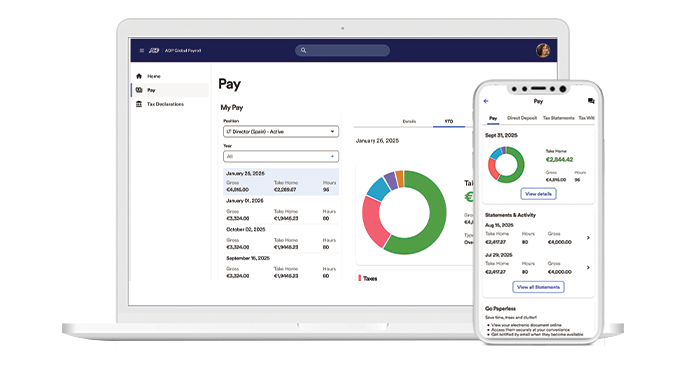
ADP’s performance management software connects directly to employee data and payroll processes. This provides a clearer view across performance, development and reward, supporting more consistent decision-making across the organisation.
Part of a wider talent approach
Performance management systems work best when connected to:
- Learning and development – Identify development needs and connect performance conversations to targeted learning and career growth opportunities.
- Succession planning – Highlight high-potential employees and support decisions about future leadership and critical roles.
- Workforce data and reporting – Combine performance data with broader workforce insights to support more informed people, reward and planning decisions.
ADP allows these areas to work together, so performance data informs development, progression and planning decisions.

How performance management supports different business functions

HR and people teams
Standardise performance processes and maintain consistency across teams and locations.

Managers and team leads
Set expectations, provide feedback and track individual and team progress.
Leadership teams
Access consistent performance data to support workforce planning and decision-making.
Organisation-wide
Improve visibility of performance, support development and reduce reliance on inconsistent processes.
Getting your performance processes in place doesn’t need to be complex — here’s how it works:
1
Speak to our team
Discuss how performance is currently managed and where processes lack consistency or visibility.
2
Define your performance framework
We help align goals, feedback cycles and reporting with your organisational structure and priorities.
3
Get started with structured performance management
Introduce a consistent approach supported by ADP, with onboarding to ensure adoption across teams.
Explore connected HR and talent solutions

Connect performance processes with recruitment, onboarding and wider talent workflows.

Maintain consistent employee data and reporting across HR and payroll systems.

Manage hiring and onboarding processes that feed into performance and employee development.
FAQs
How does performance management software connect with payroll and HR?
Performance management does not operate separately from the rest of your organisation. With ADP, performance data connects directly to HR and payroll systems, giving you a consistent view of employee performance, progression and reward. This helps ensure decisions around pay, development and retention are based on the same underlying data.
How do organisations make performance management consistent across teams?
Inconsistency often comes from teams managing performance in different ways. A structured approach introduces shared processes for goal setting, feedback and reviews, supported by a single system that allows visibility across departments. This makes performance easier to compare, manage and improve across the organisation.
Can performance management be introduced without replacing existing systems?
Yes. Many organisations begin by introducing clearer processes and improving visibility before consolidating systems. Performance management can be improved incrementally, depending on how your current processes are structured.
What challenges do organisations typically face with performance management?
Common challenges include unclear goals, inconsistent feedback, reliance on manual processes and limited visibility of employee progress. These issues often make it difficult to manage performance fairly and consistently across teams.
How does ADP support performance management as organisations evolve?
ADP provides a framework that connects performance management with HR, payroll and wider talent processes. This allows organisations to maintain consistency while adapting how performance is managed as team structures, priorities and requirements change.
Start managing performance more consistently across your organisation
By submitting this form you are informed that ADP may contact you about its products, services, and offers, according to our Privacy statement for Business contacts.
Let's find the perfect solution for your business
Fill out the form and see what the ADP team of payroll and HR experts can do for you.